
The Journal · July 2026
The Flower That Bleeds Purple
My sisters and I nabbed the majority of the Black Dragon Iris from my father's garden before the sale was finalized. We text photos of our gardens every spring like a seasonal roll call or a low tide pick me up. The irises carry forward memories of those who we loved and the garden they grew — the walks looking at how the clippings took or how the bulbs filled out, the arrangements made from their cuttings, the smiles they brought and the peace that was had.
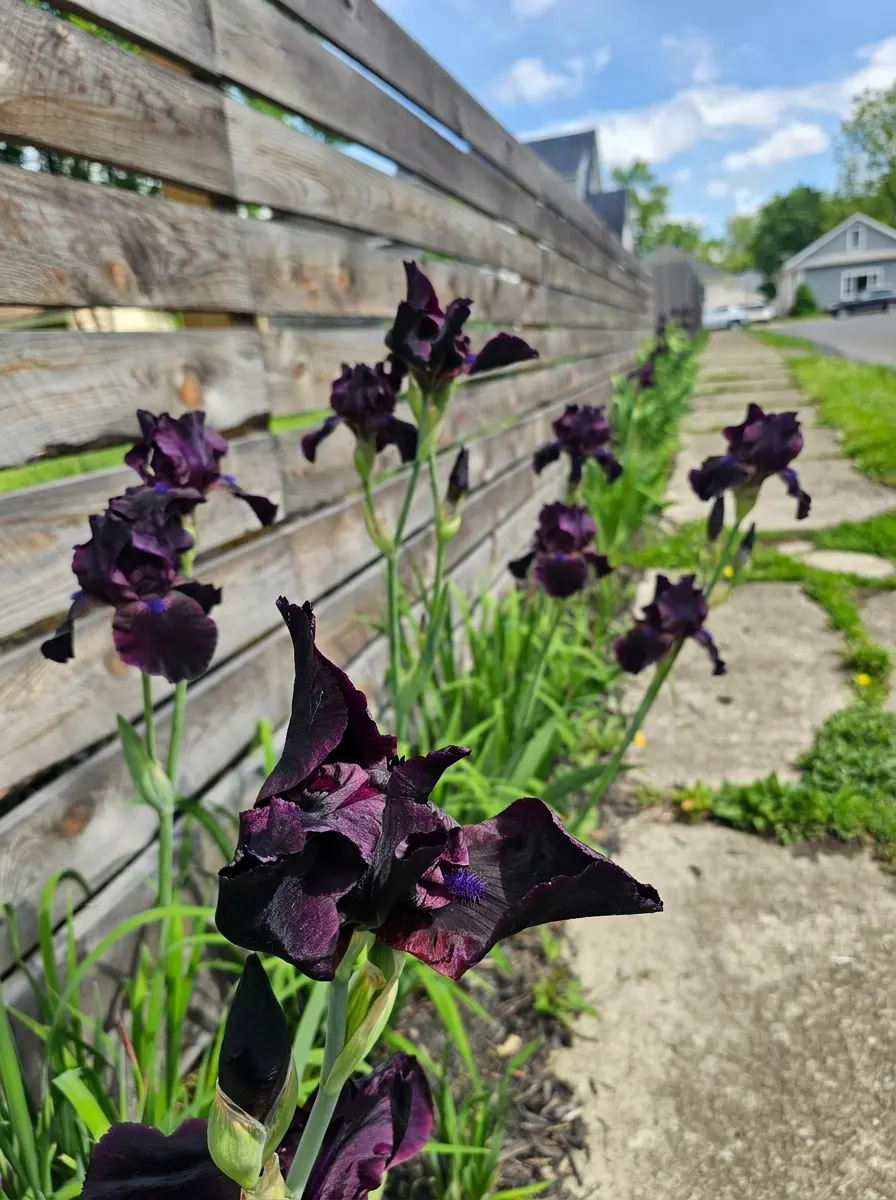
I planted my black iris along a new fence line and they bloomed the very first year, which felt like my dad's silent love. This year the flowers have tripled in an absolute show of flower ego.
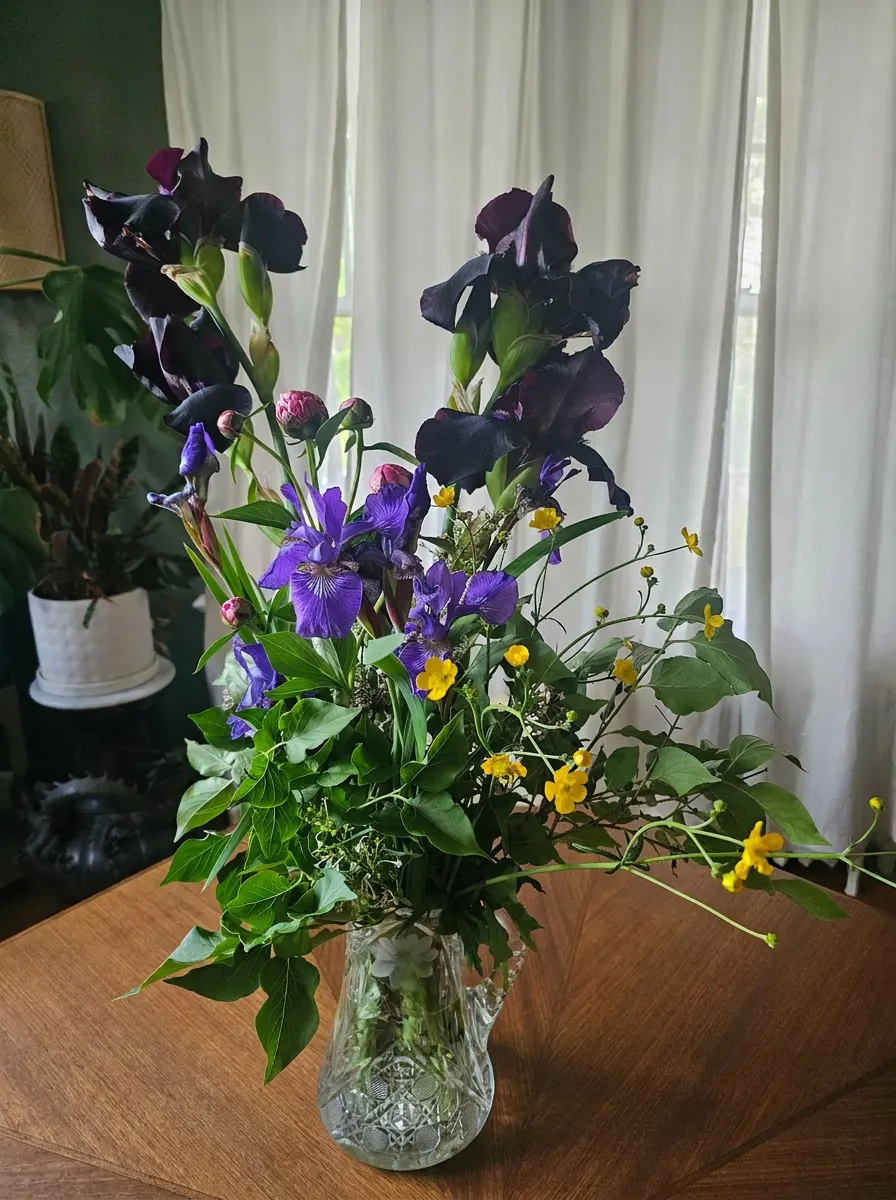
I brought a couple black irises in with my first peony, which came with the house purchase a few years ago and almost died of shade. I created a messy garden arrangement and snapped a photo for my sister because she was having a hard day. I made a second, and I tried to do it Ikebana style — with minimalistic lines in a funky container, but it was more faux or quasi, like my friend Dayna Thacker calls it in her series called such quasi-Ikebana. I have a funky blue glass container the kind of vessel that says "I understand negative space." I cut the Black Dragons, brought them inside, tried to think in lines rather than bunches. I arranged them in tall elegant and simple lines, the small unusually shaped pot laced with a 'frog' of stems to hold them exactly in the right place. The result was what a generous friend might call Nageire-adjacent. What an honest friend would call very tall flowers in a short pot.
Irises don't hold up well, but while I wasn't looking, these black iris bled — literally — dripping a dark purple and stained my mid-century modern table! Gasp, not sure how I will get that out, and also, do people covet these black iris flowers for natural fabric dye? How might an artist incorporate black iris to fabric processing or fabric art.
The Flower That Bleeds Purple
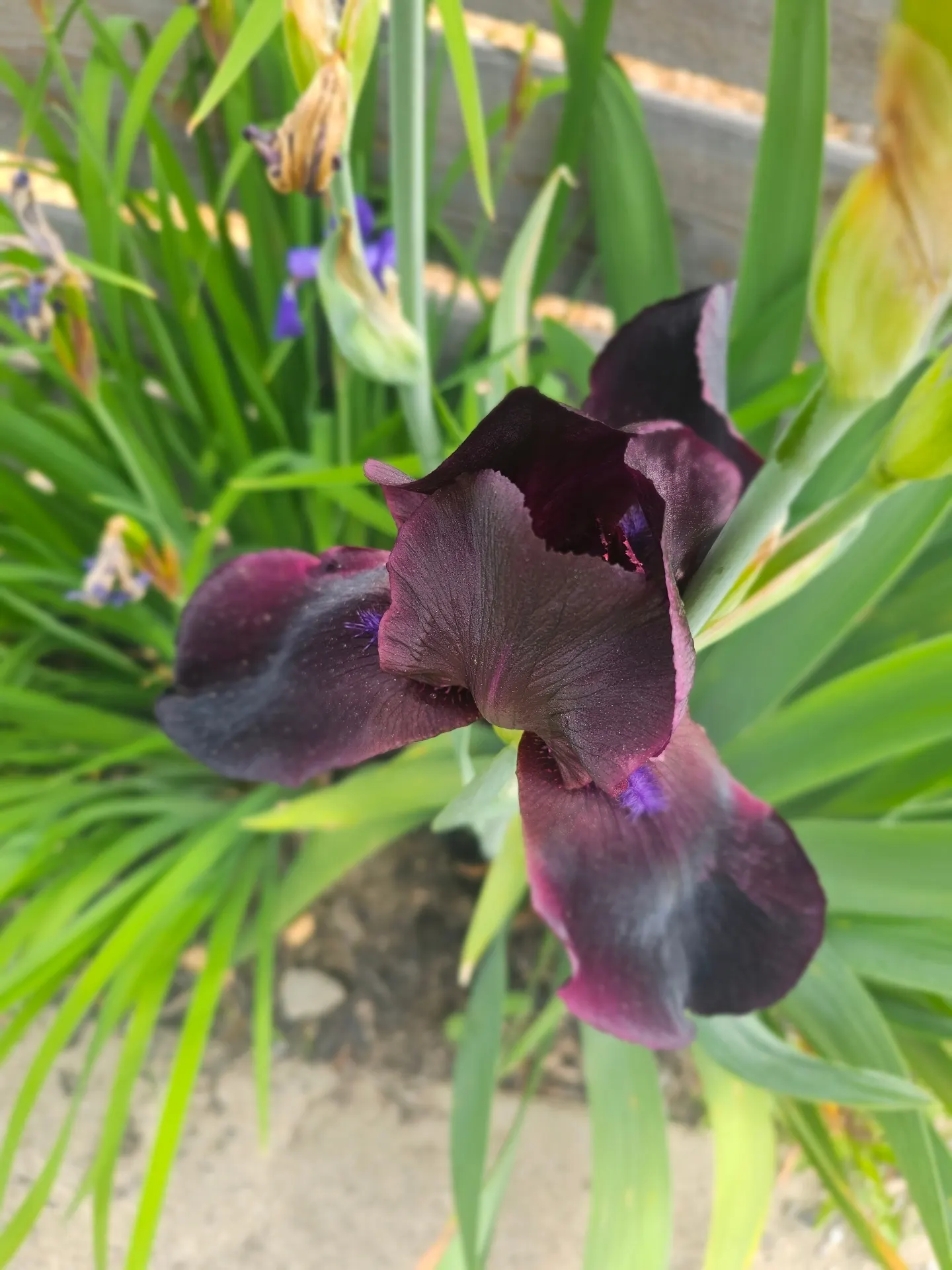
'Black Dragon' — Iris germanica, tall bearded variety, enormous, dramatic, and currently thriving along my new fence line in a way that frankly feels like showing off. It is not actually black. Nothing called a black flower ever truly is — black flowers are dark purple pretending, and Black Dragon does it better than almost anyone. The blooms are a deep, almost-velvety blackish-purple with a striking blue signal patch in the center. The flowers really like to hide their beauty with the three upward-facing petals (standards) closing off the top of the flower — which also makes it sort of difficult to photograph. I have attached a photo here, but I didn't get one of my Ikebana arrangement.
Sharing the fence line are gladioli, dahlias, and Dutch iris — a whole chorus line of drama — but Black Dragon is the diva this year. The blooms are bigger than my fist. They tower. They pose. And thanks to the table incident, they will never see the inside of my house again.
The Big Iris Family
Here is a number that will reorganize your relationship with the genus Iris: 50,000 registered varieties. From roughly 325 species, human hybridizers — obsessives, really — have registered fifty thousand named cultivars. The bearded iris alone accounts for over 60,000 variants if you count every cultivar ever developed. The iris family spans everything from five-foot giants to plants barely eight inches tall, and they grow on every continent except Antarctica and, oddly, Hawaii.
The Black Dragon Iris is a tall bearded iris which traces its bloodline back to the Balkan peninsula, where two Mediterranean species — Iris pallida and Iris variegata — crossed naturally and produced the ancestor of everything we call a German iris today. The "German" part is actually a 1753 mistake by the botanist Linnaeus, who received a specimen from a German garden and assumed that's where it was from. It is not from Germany. Germany does not grow it wild. Linnaeus was brilliant and also wrong about this.
The specifically dark-to-black cultivars are an American obsession, twentieth century, Oregon (go figure, my second heart) in particular. The reigning ancestor of most modern "black" irises is 'Superstition', introduced by Schreiner's Gardens in 1977 — still operating out of Salem, Oregon, by the way, this is a new place on the list for me. They have been growing and hybridizing irises since 1925. They are the reason 'Superstition' exists. They are the reason 'Before the Storm' exists. They are, by several degrees of separation, the reason Black Dragon exists, and the reason there is a stain on my table. I may try to hold them responsible and I absolutely plan to visit.
From 'Superstition' came 'Before the Storm' (1989), which won the Dykes Medal in 1996 and is still considered one of the darkest irises in existence. 'Black Dragon' is a direct descendant of this lineage — which means my fence-line flower is the product of decades of dedicated human effort to breed a bloom that absorbs light instead of reflecting it. It is doing what it was designed to do. The stain on my table is, technically, intentional design working correctly.
Now: the dye. That dark purple bleed contains delphinidin, an anthocyanin pigment with a genuine affinity for natural fibers — linen in particular. Research on Iris germanica 'Black Dragon' specifically found it produced colors ranging from deep purple to blue on linen, with the best results when the fabric was pre-soaked in alum as a mordant. The catch is that petal dye is "fugitive" — it fades over time without careful fixing chemistry. Artists use it anyway, for exactly the same reason we love the bloom: the color while it lasts is extraordinary.
The real permanent color bleeder is the root of the yellow flag iris, Iris pseudacorus. Simmered roots with an iron mordant produce a deep charcoal-to-black on wool and silk that has been used in Scotland and across northern Europe for centuries. The best time to harvest is autumn, when tannin concentration in the roots peaks. There is a stand of yellow flag iris growing in a ditch not far from my house. I have been meaning to harvest the leaves for basket-weaving every fall for two years. The city mower gets there first. Every single time. So, now if I miss the leaf window, I'll still have this root idea.
(I am cool with taking the yellow roots, they can get weedy and I personally think yellow and brown irises lack sufficient contrast to their green leaf collaborators. So, the less the better. Sorry, not sorry.)
Flor de Lis
My father grew irises. His mother grew irises. My mother's family grew irises. My sisters and I have been texting each other iris photos every spring for years — the unofficial announcement that the season has started, that we are all still here, that dad's green thumb is showing up again this year, we can absorb that sense of peace.
Irises travel by rhizome. You dig them, divide them, throw them in a paper bag and into the back of the car – go time, high speed NY country road race game on. Things move fast when we are on an iris mission. Irises skip seed packet and expensive perennial shelves, they go rogue from hand to hand, yard to yard, generation to generation, and the only record of the transfer is memory. We have carried irises and hostas on planes in suitcases before. These black dragons though, they are hardy, they flowered the first season, which felt like silent sign of love. This year, they are happy and the flowers have tripled.
This is how plant lineages move through families — not by inheritance or purchase but by gifting. My irises are related to my sisters' irises. They are probably related to my grandmother's irises. They might be, distantly, related to irises growing in someone's garden across town who got a rhizome from someone who got one from someone else, all the way back.
I made a Ramsey family crest a few years ago — elements of a traditional Scottish emblem, but personalized by me and complete with irises. Not because irises are on every heraldic crest (though the fleur-de-lis, technically an iris, has been a symbol of European royalty). I included them because they are symbols of heritage and courage. Something that pulls up at your table and leaves its mark.
Door to Dye
These black iris petals, a length of linen and an alum mordant bath and an afternoon, you have a dye experiment. The catch: petal dyes are fugitive, so they fade unless fixed with care. The color will be blue-purple, organic, slightly unpredictable, and will age into something softer over time. That might be exactly what you want.
If you want permanent, look at the roots of the Yellow Flag Iris ( Iris pseudacorus) — the one you probably drive past in a ditch somewhere without realizing it is a centuries-old textile tool. Harvest in autumn. Simmer slowly. Add iron. The tannins from the yellow flag iris are more permanent and will do something quietly extraordinary to wool.
Hudson Valley artists like Michelle Moore (Kingston, instructor at SUNY Ulster) are hammering iris petals directly onto silk to create wearable botanical prints — ghost-images of blooms transferred to fabric by percussion. Katrina Rodabaugh, based in Claverack, has been teaching foraged natural dye workshops using exactly this kind of local plant material. The Hudson Valley Fiber Arts Network connects botanical textile makers across the region if you want to find your people. I'll be keeping an eye on their projects — and I hope to share more about their work in a future post.
Every spring when the fence line blooms again and my phone lights up with a photo from one of my sisters, I'll know exactly where the iris came from, and whose hands it passed through to get here. Some plants just have that kind of gravity.
Botanically Bound is a curated marketplace where plant lovers and botanical makers unite. This blog is where we think out loud about the plant world — the science, the stories, and the things that make us stop mid-stride in someone else's yard.