
The Journal · June 2026
Ash Transformed: The Taghkanic Basket Makers
Like a good basket, my father tried to weave experiences into my growing up. He was a public school teacher with an outsider's sense of adventure — always pulling me somewhere unexpected, always pushing toward the edges of the ordinary. He relished bringing me to atypical places and exposing me to people whose lives were different than mine. Constantly outgoing, forever engaging strangers — an elementary school teacher who pushed everyone, students and children alike, to get out of their comfort zones and take pride in the place they came from. He had a historian's love for Columbia County and knew a woman, Lizzie Proper, in Taghkanic who made baskets.
It was the late 1980s and I recall that I wasn't as excited about this visit as he was. We left Germantown, racing across the winding back roads, lined with mosaics of green. We drove up a remote road and went inside to meet with Lizzie. My dad was pretty chatty, but he was a good listener. Looking through her baskets, Lizzie spoke a bit about how she made them — how she was, quite literally, turning a tree into an entirely new commodity. I had a lot of exposure to farming and selling food, but this was different. A farm's lifecycle is nurture, grow, harvest; basketmaking is harvest, process, transform.
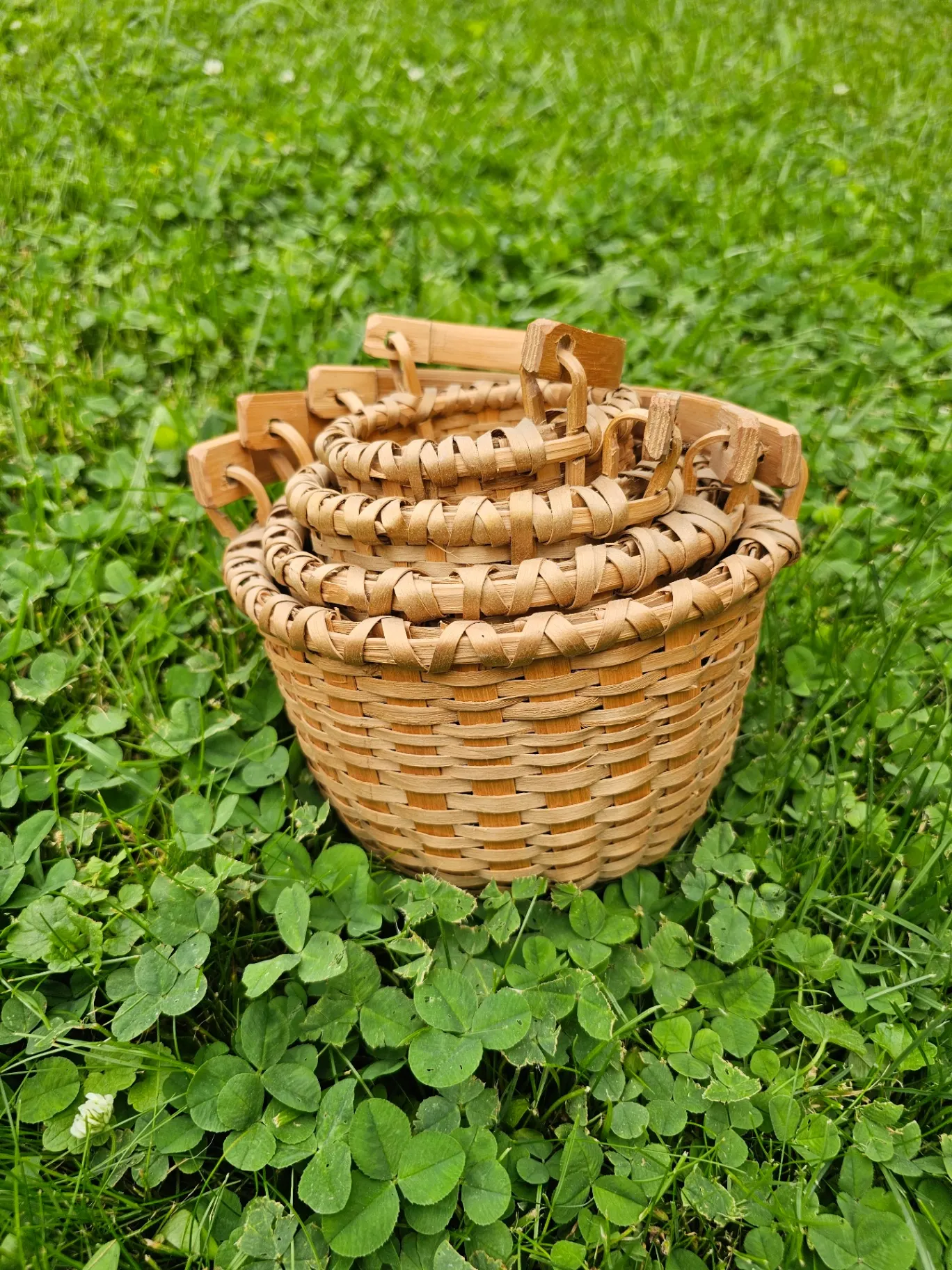
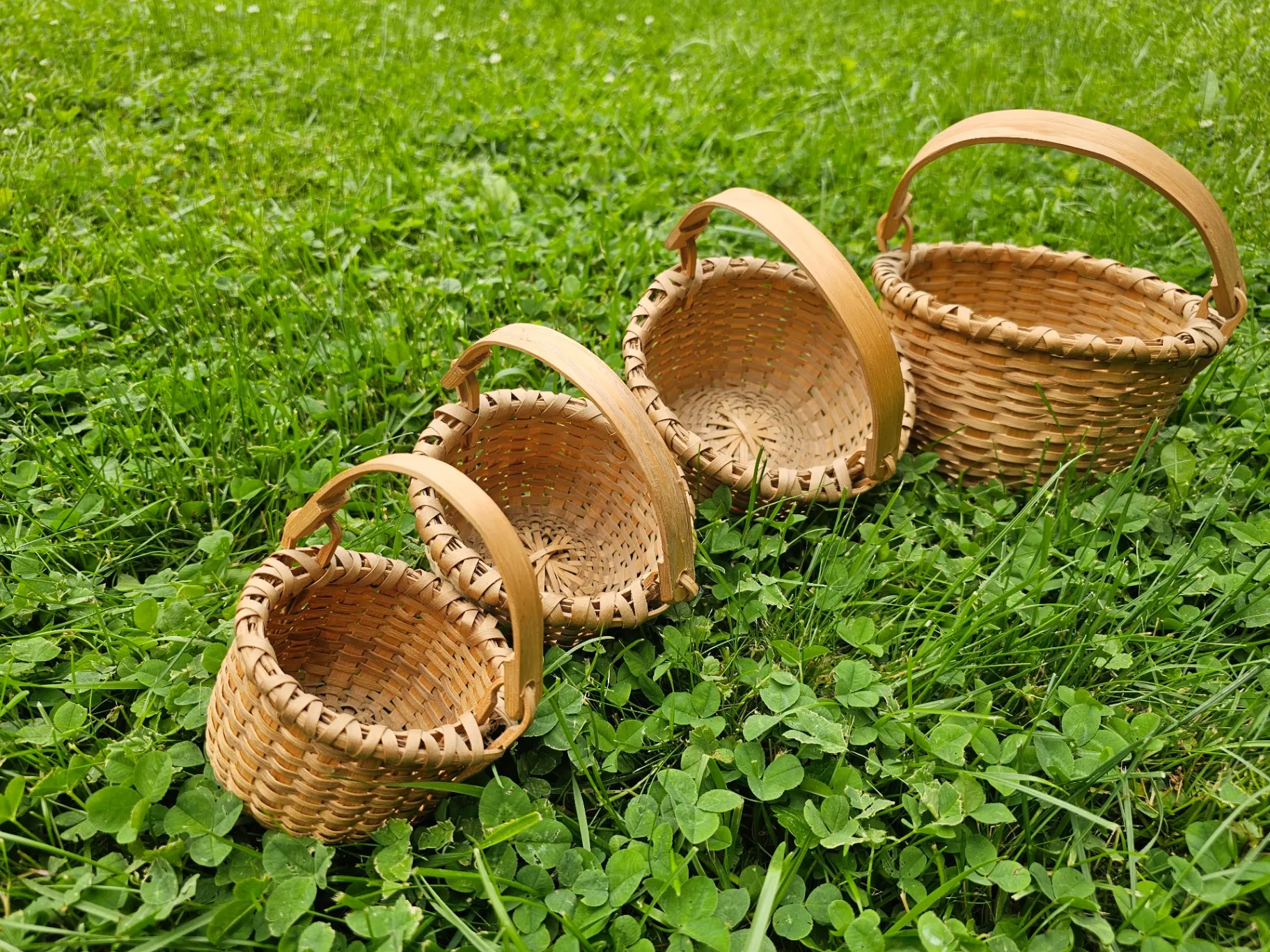
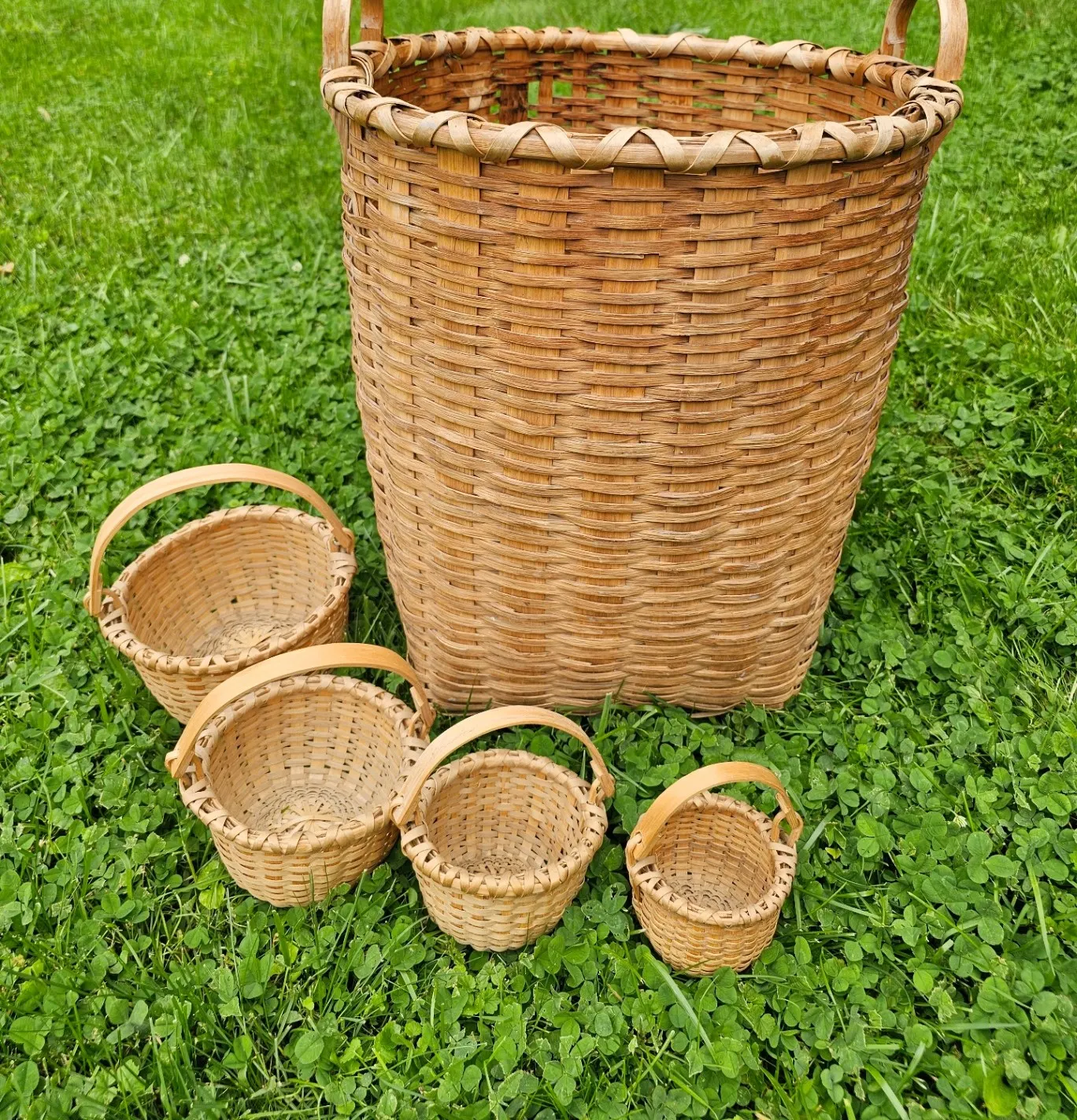
I left absolutely fascinated — the experience changed how I saw plants. We finished our visit and my dad bought a stack of four nesting baskets from her. I still have them, and I'll include a photo.
Taghkanic: At Essence, an Experience
The name Taghkanic originates from the Algonquin Indians, and depending on your source, it means "water enough," "full of timber," "forest wilderness," or "in the trees." Other sources give it simply as "in the trees." On the surface these sound like competing answers.
Columbia County's landscape spans the Hudson River to the Taconic Mountains, and the area produces an amazing range of biological abundance. Roughly 60 to 80 tree species naturally occur in the county, and across all vascular plants, the county hosts something on the order of 1,550 wild-growing species — trees, shrubs, and herbs — which represents more than a third of New York's total known flora. The canopy mixes northern hardwoods with central Appalachian species. The lowland areas flood seasonally, forming the marshes and creek margins where black ash thrives. The ridgelines catch moisture off the Hudson and send it back into the watershed.
Indigenous place names describe a relationship, an experience, a way of inhabiting a landscape. When you stand at Lake Taconic and look around, it is a place of all these things. Depending on the person, any of those experiences can be had and all the translations can collapse into one. Forest and water and enough: these are not three different concepts. They are one place, experienced from within, what it felt like to be there.
The land has changed enormously since the Algonquin — cleared for farming, regrown as second growth, subdivided, managed, neglected in patches, rewilding and gentrification. But the biological engine underneath is still running. The ash still grows in the wet places. The creek still moves.
Wetland Tree Species
The baskets were woven from Black Ash (Fraxinus nigra) primarily, or white oak (Quercus alba or Quercus bicolor) and shagbark hickory (Carya ovata) for rims and handles. Black ash wood can be disassembled by pounding, which makes splints for weaving. Trees grow with annual growth rings, but Black Ash forms rings of two types of wood: spring wood grows rapidly and forms a loose connective layer linking the previous and next summer's growth. Soaking and pounding Black Ash with a mallet crushes the spring layer and allows the summer wood to be peeled off in long strips.
Each strip in a basket represents one year of the tree's life.
A black ash tree must be at least 25 years old before it can be harvested. It seeds every five to seven years, and seeds take two years to germinate. It grows in wet ground — lowland forests, creek margins, the edges of swamps — exactly the landscape the basket makers lived in and around. A single 16-inch diameter tree can be taken apart ring by ring, right to the core. A good tree can produce enough splints to make 500 baskets, but the pounding process requires about seven to ten days of work at eight hours a day. That is before a single strip of weaving has begun.
Splints vary in color according to where they lie in the tree — sapwood, the outer layer where moisture is currently flowing, is lighter, and heartwood at the core, where moisture once flowed, is darkened with age. A skilled weaver can read a basket's construction the way you might read growth rings on a stump. The handles and rims are shagbark hickory, bent into shape while green and hardened into the finished form. The basket as a whole is a collaboration between species.
When you hold one, you understand immediately that it was built to be used hard — not to sit on a shelf, but to carry berries, store grain, and survive the daily work of a working household. Some folks say the baskets were woven so tightly they held water.
The Test of Time
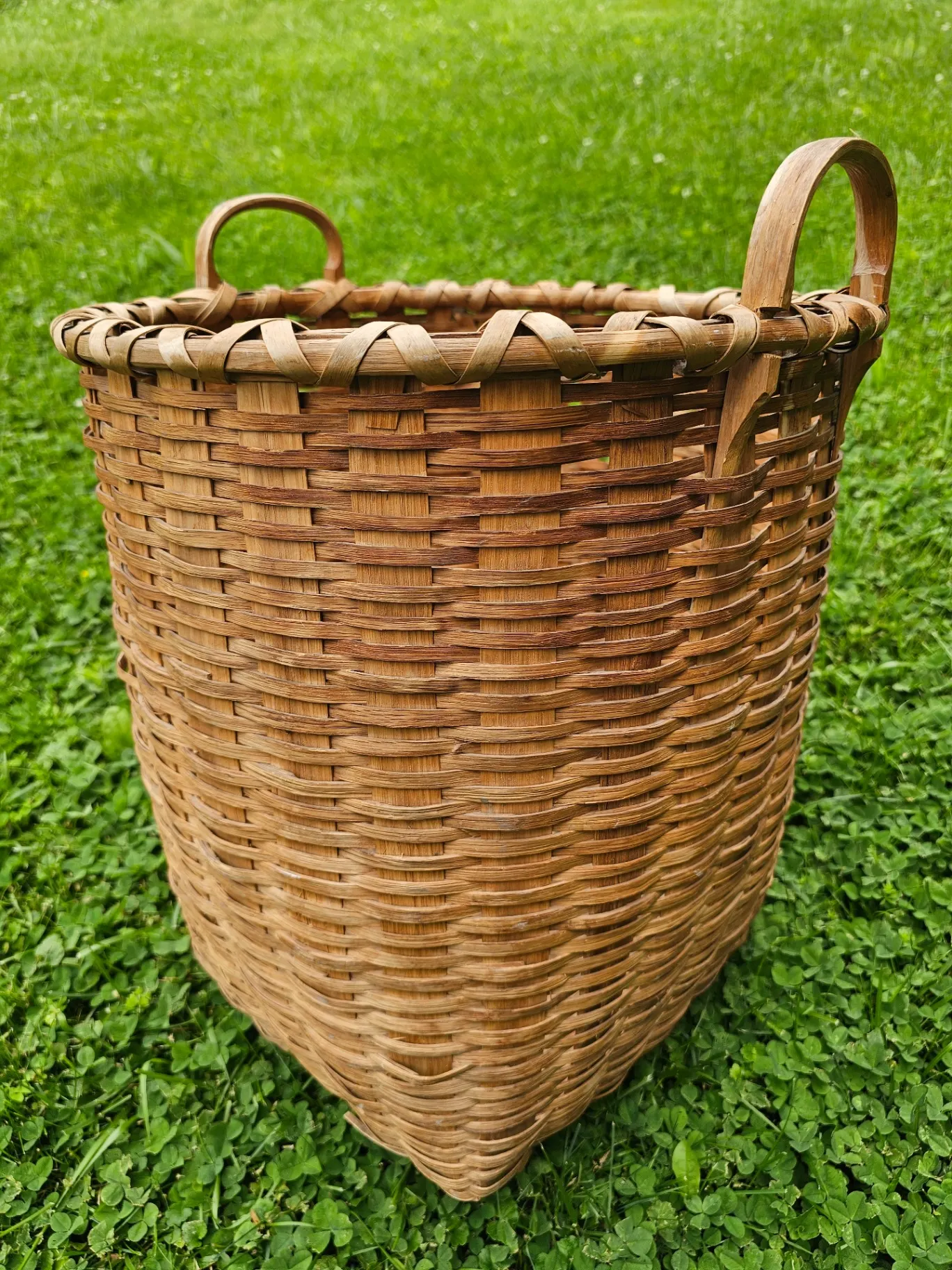
My Aunt Joyce still lives on our family farm in Linlithgo. I'm sure she was as resourceful at five in the 1950s as she is today in her eighties. She remembers her grandmother and mother doing laundry on Mondays, if it didn't rain. Her grandmother had a well; her mother only had a cistern. So it was better to do the laundry of both houses at her grandmother's. She told me: "My grandfather, Palzi, had two women in his life — his wife and my mother — so when he bought something for one, he bought it for both. I remember him taking me out to Route 82 and buying some laundry baskets from a roadside stand. Palzi died when I was fourteen, so that would have been in the 1950s."
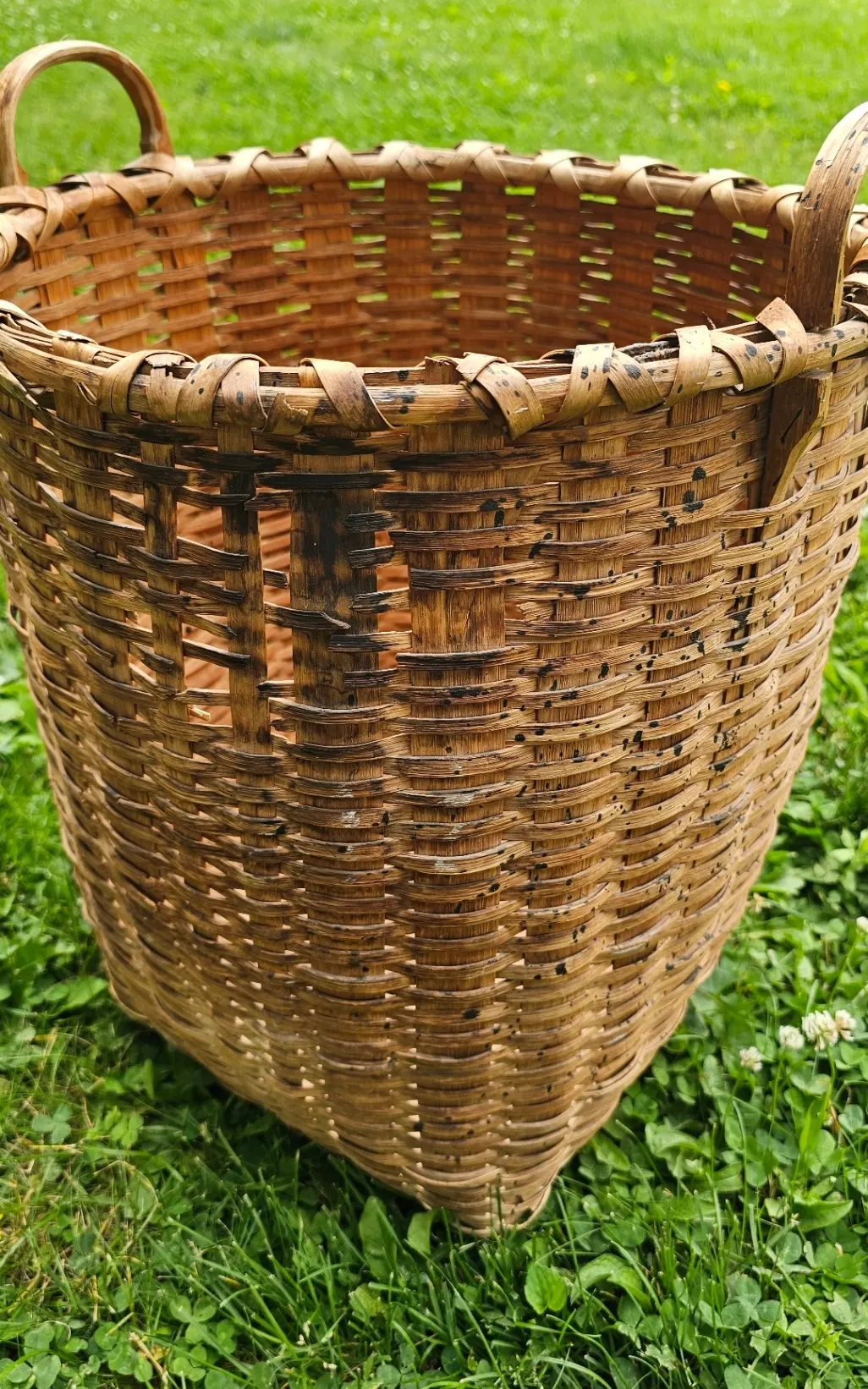
My grandmother collected everything and had a collection of Taghkanic baskets. I have kept one for thirty years. It survived a house fire at my grandparents' place in Linlithgo in the 1960s. The sides are stained a deep permanent smoke-dark, but it did not burn through. Ash does not give itself up easily. It came through structurally intact, carrying the evidence of what it had been through. Even where the crosshatches are burned, it doesn't unravel.
That is what the Taghkanic makers built — requiring no manufacturing facility, no petroleum inputs, no shipping container. The basket makers on Stovepipe Alley lived that intelligence for generations — not decorative objects, but working ones, made well enough to outlast fire, rough use, and the better part of two centuries. An object made entirely from a tree, by hand. They were also making some of the finest functional objects from materials they harvested themselves, using knowledge passed across generations. The baskets endure because the people who made them endured — stubborn, skilled, rooted in place.
Nothing to Prove
Those non-conforming, unruly souls who choose a different path — who do what it takes to survive — have always captured my attention. The Taghkanic Basketmakers were those kinds of people: rooted, inventive, shaped by the land they lived in and the materials it offered.
Society doesn't always see these folks clearly. The poor often got read as lesser, and rural as unsophisticated. But these were people who made objects of extraordinary precision and durability — baskets that outlasted houses, fires, and the judgments placed on the hands that made them. The people who work closest to those materials are practicing a kind of intelligence. Not objects as artifacts, not plants as specimens — the intelligence that lives in hands that transform ash into a basket.
My father kept racing around, me in tow for his whole life. He thought the world was worth seeing, and exposure to an array of things was investment in odds — maybe an experience would stick, maybe a seed planted would grow.
The Taghkanic makers lived the same way: work with what you have, trust your hands, keep going. Not everything holds. But the things that do, last.
Lizzie Proper's daughter, Maryann Barto, still weaves and has written about growing up in that world. I just ordered her books. You can find her on Facebook.
Spotted in the Wild
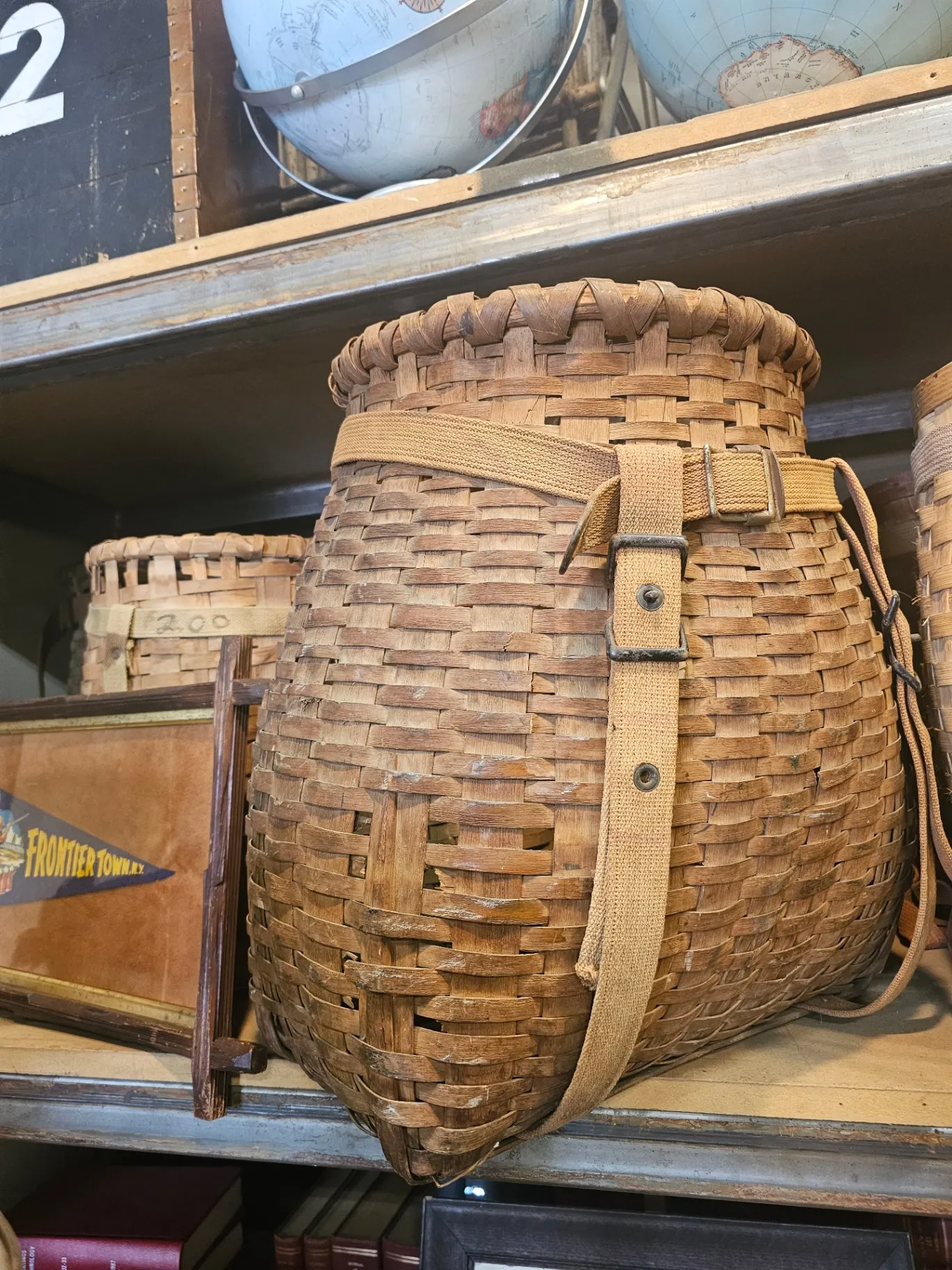
I stopped in my tracks for these. The form is unmistakable — pounded ash splint, single-weave body, wrapped rim, that pot-belly swell narrowing to a tapered base, original canvas harness still buckled on. The dealer called them Adirondack. They might be. They might also be Taconic. The pot-belly pack basket was made up and down the Northeast, and without a maker's mark or a paper trail, the regional label is a best guess — an educated one, but a guess.
That ambiguity is the whole point. Baskets travel. They get sold, gifted, inherited, abandoned in barns, rescued from estate sales, retagged by dealers two counties over. The hands that made them slip out of the record, and what's left is the object — still holding its shape, still doing its job, still asking to be read.
Botanically Bound is a curated marketplace where plant lovers and botanical makers unite. This blog is where we think out loud about the plant world — the science, the stories, and the things that make us stop mid-stride in someone else's yard.